How to Install Solar Panels in Africa: Best Tilt Angle, Direction and Practical Tips
From Solar Installer to Full-Service Solar Provider: How One Customer Expanded His Business
Introduction
In the solar industry, many businesses start with a simple service: solar system installation.
They have technical skills, installation teams, and experience working directly with homeowners and local businesses.
However, there is an important limitation.
When customers need a complete solar system, installers often have to purchase batteries, inverters, solar panels, and other components from different suppliers.
This can create challenges in:
- Product selection
- System compatibility
- Pricing
- Delivery
- After-sales service
- Project management
One of our customers faced exactly this situation.
After discussing his business model with us, he decided to expand beyond installation services and start providing the complete solar systems and components his customers needed.
The result was a significant change in the way he operated his business.
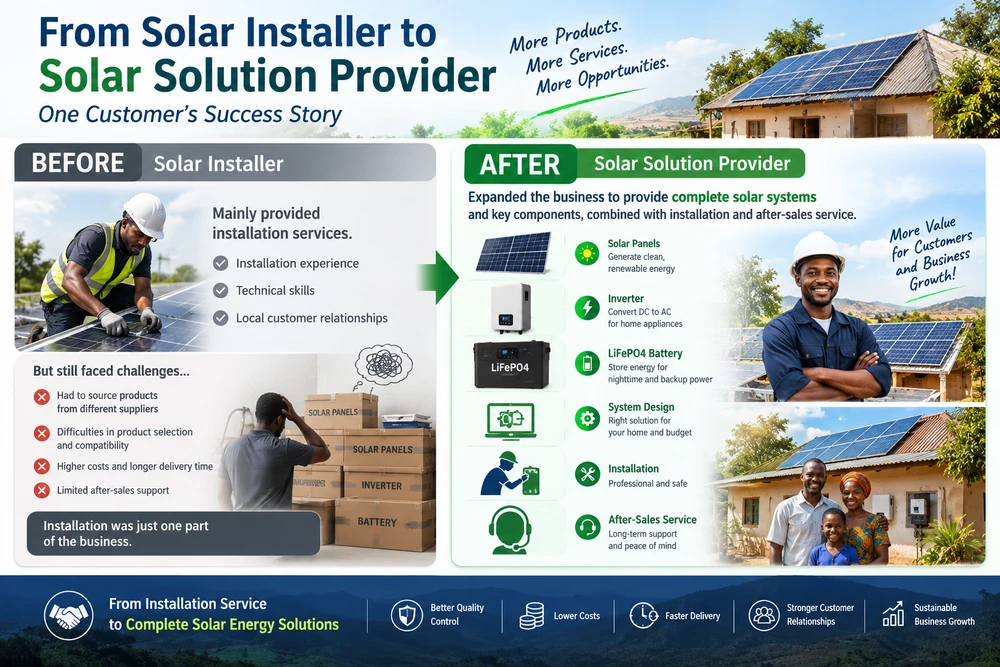
The Customer’s Business Before
Our customer originally focused mainly on solar system installation.
His strengths were clear:
- Professional installation experience
- Understanding of local customer needs
- Technical knowledge
- Existing customer relationships
But when customers wanted a complete solar solution, he still needed to source the products separately.
For example, one customer might need:
Solar Panels + Inverter + Battery + Protection Components + Installation
The installer could provide the installation service, but the equipment often came from different suppliers.
This meant the customer had to coordinate multiple parts of the project.
The Challenge: Installation Was Only One Part of the Business
As the solar market developed, customers began expecting more than installation.
They wanted someone who could answer questions such as:
What size solar system do I need?
Which battery capacity is suitable?
Which inverter should I use?
How many solar panels are required?
Can the battery and inverter work together?
Who will provide after-sales support?
The installer was already the person customers trusted.
But without a reliable product supply chain, it was difficult to provide the entire solution.
Our Suggestion: Don’t Just Install Solar Systems — Provide Them
We suggested that he consider expanding his business model.
Instead of being only a:
Solar Installer
he could gradually become a:
Solar Energy Solution Provider
The difference is important.
Instead of only charging for installation, the business could provide:
Solar Panels
For generating clean electricity.
Solar Inverters
For managing and converting solar energy.
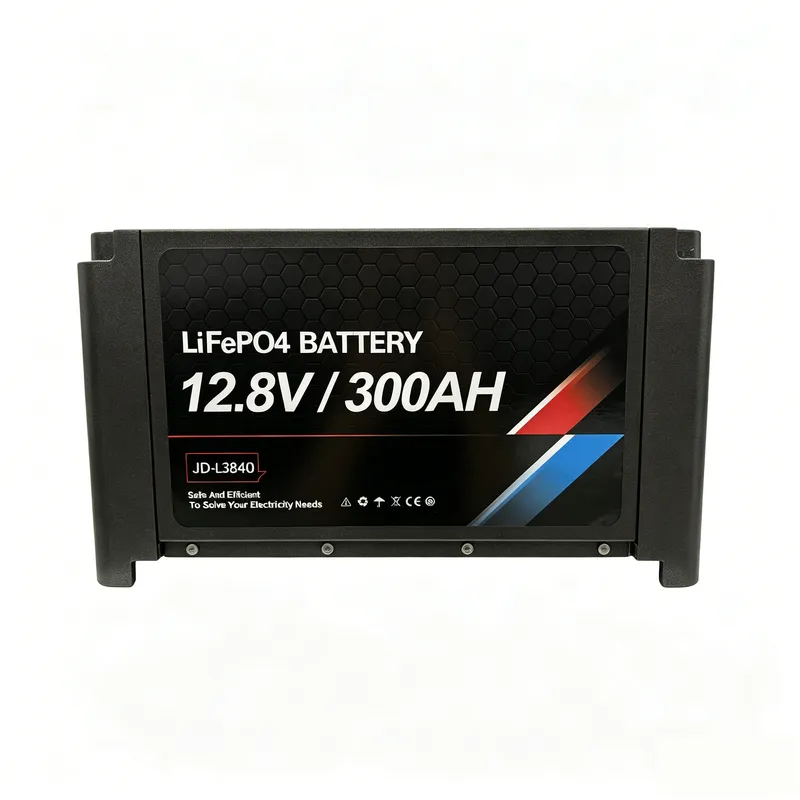
LiFePO4 Batteries
For storing energy for nighttime use and backup power.
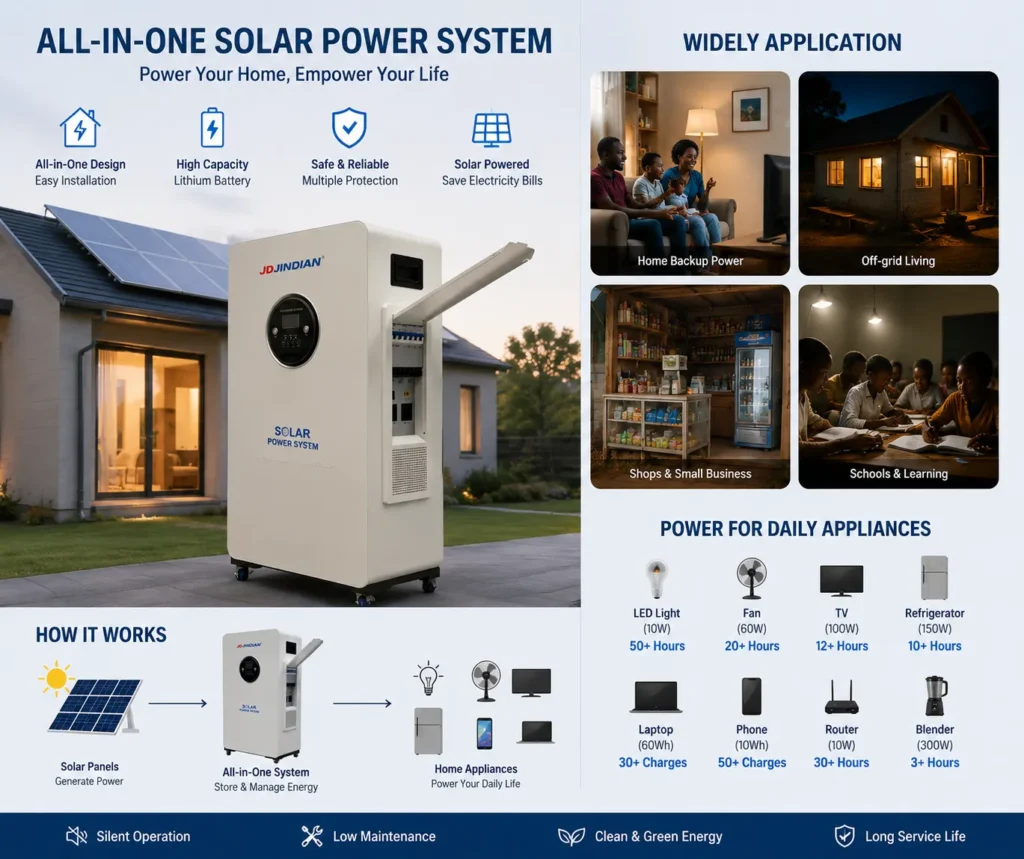
Complete Solar Systems
Pre-matched systems designed according to customer requirements.
Installation Services
The customer could continue using his existing technical expertise to complete installation.
This created a complete business chain:
Product Supply → System Design → Sales → Installation → After-Sales Service
A New Business Model
The customer began thinking about the entire customer journey rather than only the installation stage.
For example:
Step 1: Customer Has an Electricity Problem
The customer wants reliable electricity for their home.
↓
Step 2: Customer Contacts the Solar Installer
The installer evaluates their electricity requirements.
↓
Step 3: System Design
The installer recommends the appropriate:
- Solar panel capacity
- Battery capacity
- Inverter power
↓
Step 4: Equipment Supply
The required products are supplied as one complete package.
↓
Step 5: Installation
The customer’s installation team completes the project.
↓
Step 6: After-Sales Service
The same company remains responsible for supporting the customer.
This is much more than installation.
It is a complete solar energy service.
Why This Created New Opportunities
Expanding from installation to product supply gave the customer more opportunities to serve different types of customers.
Previously, the business was mainly focused on:
Installation projects
Now it could also work with:
- Homeowners
- Small businesses
- Rural households
- Property developers
- Local solar installers
- Small distributors
The business was no longer limited to customers who already had their own equipment.
It could provide the complete solution.
One Supplier, One Complete Solution
Another important advantage was simplifying procurement.
Instead of sourcing different products from different suppliers, the customer could purchase multiple components through one supply chain.
For example:
Solar Panels
Inverter
LiFePO4 Battery
Complete Off-Grid Solar System
This can make project management easier and reduce the time spent coordinating different suppliers.
For installers, compatibility between different components is also an important consideration.
A complete system should be designed around the required voltage, power, battery capacity, and application.
From Installer to Local Solar Brand
Perhaps the biggest change was not simply selling more products.
It was the change in business positioning.
An installer is primarily providing a service.
A solar solution provider can provide:
Products + Technical Knowledge + Installation + After-Sales Service
This creates a stronger relationship with customers.
Instead of customers seeing the company only as the team that installs solar panels, they can see it as the company that provides the complete energy solution.
The Long-Term Value of Building a Complete Solar Business
The solar industry is not only about selling individual products.
Customers ultimately want reliable electricity.
They don’t necessarily want to purchase a battery from one company, an inverter from another company, and solar panels from a third supplier.
They want a system that works.
This creates an opportunity for experienced installers.
If you already have:
- Local market knowledge
- Technical expertise
- Installation experience
- Customer relationships
then adding product supply can be a natural next step in expanding your business.
The Lesson for Solar Installers
This customer’s experience highlights an important opportunity:
Your installation skills are already valuable.
But you don’t necessarily have to stop there.
By adding reliable product sourcing and system design capabilities, an installer can potentially serve more of the customer’s needs.
The business can evolve from:
Installation
to
Installation + Product Supply
and eventually to:
Complete Solar Energy Solutions
Conclusion
Our customer’s journey started with solar installation.
After expanding his business to include solar systems, LiFePO4 batteries, solar panels, inverters, and other key components, he was able to provide a more complete service to his customers.
The goal was not simply to sell more products.
It was to provide customers with one complete solar energy solution from system selection to installation and after-sales support.
For solar installers looking to grow their businesses, this may be an opportunity worth considering.
Don’t just install the system. Build the complete solution around your customer.