7 Mistakes Solar Installers Make When Designing Off-Grid Solar Systems
Introduction
Off-grid solar systems are becoming increasingly popular in regions where grid electricity is unstable or unavailable.
Across Africa, many solar installers help homes, farms, and small businesses achieve energy independence through solar power.
However, designing a reliable off-grid solar system is not only about selecting solar panels and an inverter.
A successful system requires careful consideration of:
- Energy consumption
- Solar generation
- Battery capacity
- Inverter compatibility
- Future expansion
Many system failures are not caused by poor-quality products, but by mistakes made during system design.
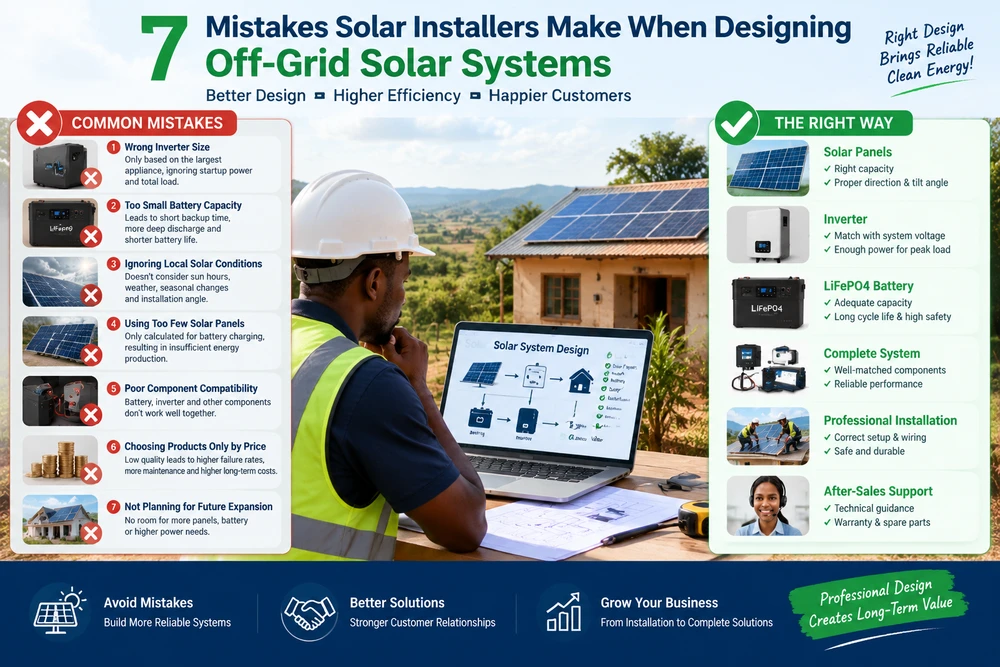
In this article, we discuss 7 common mistakes solar installers should avoid when designing off-grid solar systems.
Mistake 1: Choosing the Inverter Size Without Calculating Real Power Demand
One of the most common mistakes is selecting an inverter only based on the largest appliance.
For example:
A customer has a refrigerator rated at 200W.
The installer may think a small inverter is enough.
However, many appliances have startup power requirements.
Examples:
- Refrigerator compressor
- Water pump
- Air conditioner
- Power tools
A proper system design should consider:
- Continuous power consumption
- Peak startup power
- Number of appliances running at the same time
Better approach:
Calculate the customer’s maximum expected load and select an inverter with enough safety margin.
Mistake 2: Installing Too Small a Battery Capacity
The battery is the heart of an off-grid solar system.
Many installers focus on reducing initial costs and choose a battery that is too small.
This creates problems:
- Battery runs out quickly at night
- More frequent deep discharge
- Reduced battery lifespan
- Customer dissatisfaction
Example:
A home consumes:
5kWh electricity per day
A 2kWh battery cannot provide enough backup.
A properly designed system may require:
- 5kWh battery
- 10kWh battery
- Or a modular expandable battery system
depending on usage requirements.
Mistake 3: Not Considering Local Solar Conditions
Solar energy production depends heavily on location.
A system designed for one country may not perform the same in another region.
Important factors include:
- Peak sun hours
- Weather conditions
- Seasonal changes
- Installation angle
For example:
Many African countries receive around:
5 peak sun hours per day
However, rainy seasons and cloudy periods should also be considered.
A good design includes enough solar panel capacity to:
- Supply daytime loads
- Charge the battery
- Prepare for lower sunlight conditions
Mistake 4: Installing Too Few Solar Panels
Some installers only calculate solar panels based on battery charging.
This can lead to insufficient energy production.
Example:
A 5kWh battery:
Theoretically:
1000W solar panels × 5 hours sunlight
= 5kWh energy
This can charge the battery.
However, in real applications:
- Solar efficiency losses exist
- Weather changes
- Household loads operate during the day
A better solution is often:
5kWh battery + 2000W–2500W solar panels
This allows:
☀ Solar panels power daytime loads
↓
🔋 Extra energy charges the battery
↓
🌙 Battery supplies power at night
This improves system reliability and battery life.
Mistake 5: Ignoring Battery and Inverter Compatibility
Not all batteries work perfectly with all inverters.
Installers should check:
- System voltage
- Maximum charging current
- Communication protocols
- Battery protection settings
For example:
48V battery systems require compatible 48V inverters.
Poor compatibility can cause:
- Charging problems
- Reduced performance
- System shutdown
Before installation, always confirm that all components are designed to work together.
Mistake 6: Choosing Products Only Based on Price
The cheapest product is not always the most economical choice.
Low-cost components may create:
- Shorter lifespan
- Higher failure rates
- More after-sales problems
For off-grid systems, reliability is critical.
Customers expect:
- Stable electricity
- Long battery life
- Safe operation
Professional installers should focus on:
- Battery quality
- Component reliability
- Supplier support
- Long-term value
Mistake 7: Not Designing for Future Expansion
Many customers start with basic electricity needs but increase consumption later.
For example:
Today:
- Lights
- TV
- Phone charging
Future:
- Refrigerator
- More appliances
- Home office equipment
A good solar system should consider future growth.
Solutions include:
- Modular battery systems
- Expandable inverter capacity
- Additional solar panels
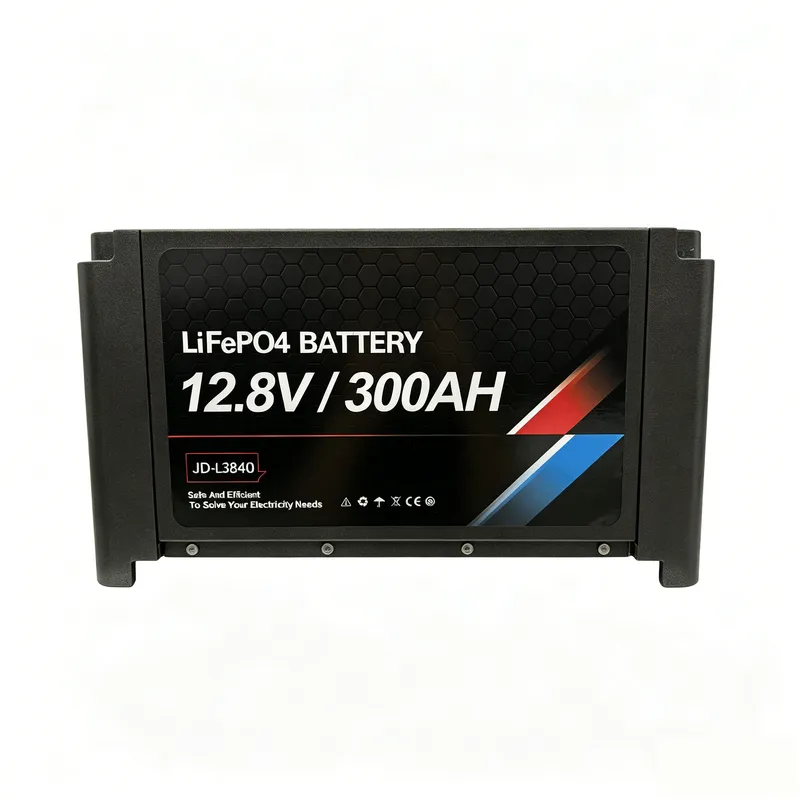
For example, stackable LiFePO4 battery systems allow users to add more capacity when needed.
A Simple Checklist for Better Off-Grid Solar Design
Before designing a system, installers should check:
Customer Energy Requirements
✓ Daily electricity consumption
✓ Important appliances
✓ Backup time requirements
Solar Conditions
✓ Location
✓ Peak sun hours
✓ Installation direction and angle
Battery Selection
✓ Capacity
✓ Cycle life
✓ Safety
✓ Expandability
System Compatibility
✓ Battery voltage
✓ Inverter power
✓ Charging parameters
Why Professional System Design Matters
A successful off-grid solar project is not just about installing equipment.
It is about creating a system that can provide reliable electricity for years.
Professional installers who understand system design can:
- Build customer trust
- Reduce service problems
- Increase customer satisfaction
- Grow their solar business
Conclusion
Designing an off-grid solar system requires more than choosing individual components.
The most common mistakes include:
- Selecting the wrong inverter size
- Installing insufficient battery capacity
- Ignoring local solar conditions
- Using too few solar panels
- Overlooking component compatibility
- Choosing products only by price
- Not planning for future expansion
By avoiding these mistakes, solar installers can build more reliable systems and provide better solutions for their customers.
A well-designed solar system is not only an installation project — it is a long-term energy solution.