How to Install Solar Panels in Africa: Best Tilt Angle, Direction and Practical Tips
How to Install Solar Panels in Africa: Best Tilt Angle, Direction and Practical Tips
Introduction
Africa has some of the world’s best solar resources, with many regions receiving abundant sunlight throughout the year.
However, simply installing solar panels is not enough.
The installation angle and direction of solar panels have a direct impact on energy production.
A poorly positioned solar panel system may lose significant power generation, reducing the efficiency of an off-grid solar system.
So, what is the best solar panel angle for Africa?
This guide explains how to choose the correct tilt angle and installation direction for solar panels in different African regions.
Why Solar Panel Installation Angle Matters
Solar panels generate electricity by converting sunlight into energy.
The more direct sunlight reaches the solar cells, the higher the power output.
The installation angle affects:
- Daily energy production
- Morning and afternoon generation
- Seasonal performance
- Battery charging efficiency
For off-grid solar systems, correct panel positioning is especially important because the battery depends entirely on solar energy production.
Understanding Solar Panel Tilt Angle
The tilt angle is the angle between the solar panel and the horizontal ground.
Example:
- Flat installation: 0°
- Vertical installation: 90°
The ideal angle allows sunlight to hit the solar panel as directly as possible.
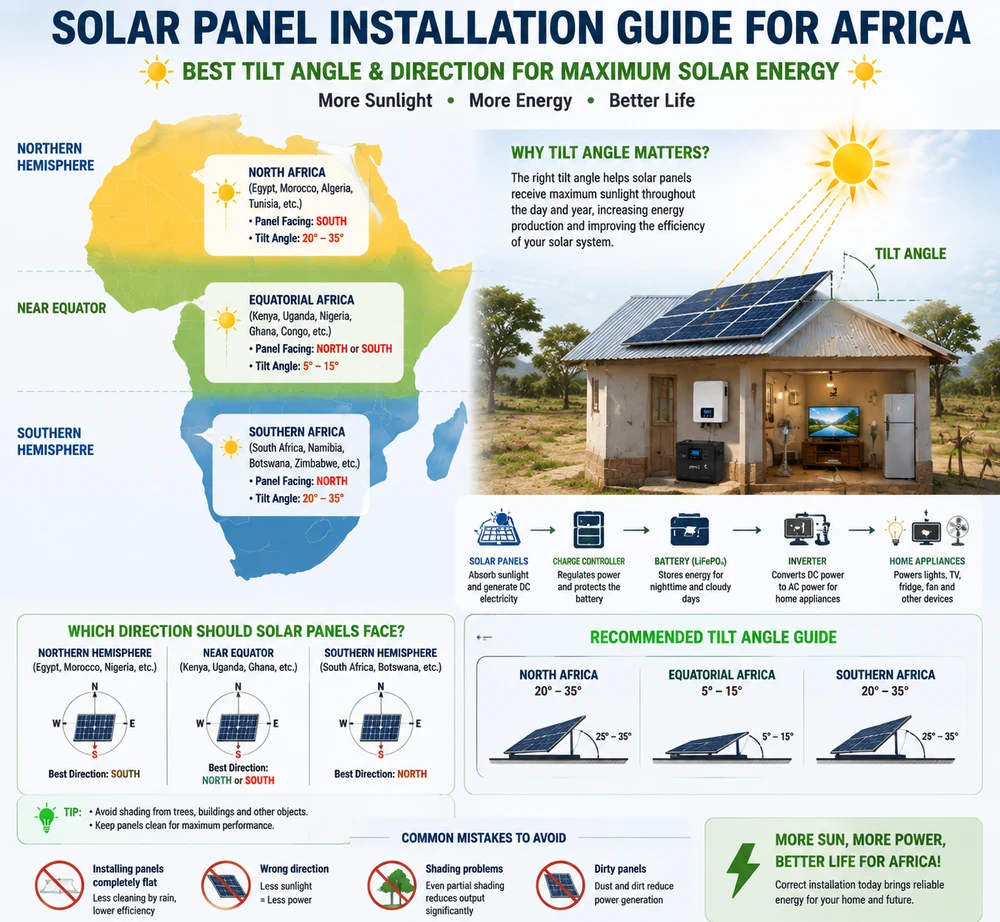
General Rule for Solar Panel Angle in Africa
The best tilt angle mainly depends on:
- Your location latitude
- Seasonal sunlight changes
- Energy demand pattern
A simple guideline:
Near the Equator
Countries:
- Kenya
- Uganda
- Ghana
- Nigeria
- Congo
Recommended tilt:
5°–15°
Because the sun is high in the sky throughout the year.
Northern Africa
Countries:
- Egypt
- Morocco
- Algeria
- Tunisia
Recommended tilt:
20°–35°
Higher latitude areas require a larger angle.
Southern Africa
Countries:
- South Africa
- Namibia
- Botswana
- Zimbabwe
Recommended tilt:
20°–35°
Solar panels should usually face north because these regions are located in the Southern Hemisphere.
Which Direction Should Solar Panels Face in Africa?
The installation direction depends on whether the location is north or south of the equator.
Countries in the Northern Hemisphere
Examples:
- Egypt
- Morocco
- Algeria
- Tunisia
Solar panels should face:
South
Reason:
The sun moves across the southern part of the sky during the year.
Countries in the Southern Hemisphere
Examples:
- South Africa
- Namibia
- Botswana
- Mozambique
Solar panels should face:
North
Reason:
The sun is generally positioned toward the northern sky.
Countries Near the Equator
Examples:
- Kenya
- Uganda
- Ghana
The best direction is usually:
North or South depending on local conditions
Because the sun passes almost directly overhead.
Recommended Solar Panel Angles for Popular African Markets
| Country | Recommended Direction | Approximate Tilt |
|---|---|---|
| South Africa | North | 25°–35° |
| Kenya | North/South | 5°–15° |
| Nigeria | South | 5°–15° |
| Ghana | South | 5°–15° |
| Egypt | South | 25°–35° |
| Morocco | South | 25°–35° |
| Tanzania | North | 10°–20° |
Actual optimal angles may vary depending on exact location.
Fixed Installation vs Adjustable Solar Mounts
Fixed Solar Mounting
Most residential solar systems use fixed brackets.
Advantages:
- Lower cost
- Simple installation
- Less maintenance
For most African homes, a fixed angle based on local latitude is sufficient.
Adjustable Solar Mounting
Allows changing panel angles according to seasons.
Advantages:
- Higher annual energy production
- Better optimization
However:
- Higher installation cost
- More maintenance
For small off-grid systems, fixed installation is usually the better choice.
Common Solar Panel Installation Mistakes
1. Installing Panels Completely Flat
Flat panels may:
- Collect dust easier
- Reduce rain cleaning
- Lower energy production
A small tilt angle helps improve performance.
2. Installing Panels in the Wrong Direction
Even a good-quality solar panel cannot perform well if it receives limited sunlight.
Always check:
- Local latitude
- Sun path
- Roof orientation
3. Ignoring Shading Problems
Avoid placing panels near:
- Trees
- Buildings
- Water tanks
- Tall structures
Even partial shading can significantly reduce output.
How Correct Installation Improves Off-Grid Solar Systems
For rural homes in Africa, solar panels are the main energy source.
Correct installation helps:
✓ Generate more electricity
✓ Charge batteries faster
✓ Reduce generator dependence
✓ Improve system reliability
A properly installed solar system allows families to get maximum value from their investment.
Conclusion
Africa has excellent solar potential, but correct installation is essential to achieve the best performance.
As a general guideline:
- Northern Africa: panels usually face south with a 20°–35° tilt
- Southern Africa: panels usually face north with a 20°–35° tilt
- Equatorial regions: smaller tilt angles around 5°–15°
By selecting the correct solar panel direction and angle, homeowners can maximize energy production and improve the reliability of their off-grid solar systems.
A well-designed solar system is not only about choosing quality components — proper installation is equally important.