
Looking for a reliable home energy storage battery?
Explore our 51.2V 300Ah 15.36kWh LiFePO4 Battery designed for residential solar systems, off-grid applications and backup power projects.
👉 View Product
How to Calculate What Wattage Solar Panel You Need for Your Battery
For solar distributors, installers, and homeowners alike, one of the most common questions when designing an off-grid energy storage system is: “How many watts of solar panels do I need to charge my battery?”
Getting this calculation right is crucial. Under-sizing your solar array means your battery will never fully charge, leading to power shortages. Over-sizing it might waste your budget.
In this guide, we will break down the exact formulas to match your solar panel wattage to your LiFePO4 (Lithium Iron Phosphate) battery step-by-step.
Step 1: Understand the Battery Capacity in Watt-Hours (Wh)
Before calculating solar panel size, you need to know exactly how much energy your battery pack can hold. Battery capacity is usually measured in Amp-Hours (Ah) and Voltage (V).
To convert this into Watt-Hours (Wh), use this simple formula:
Example:
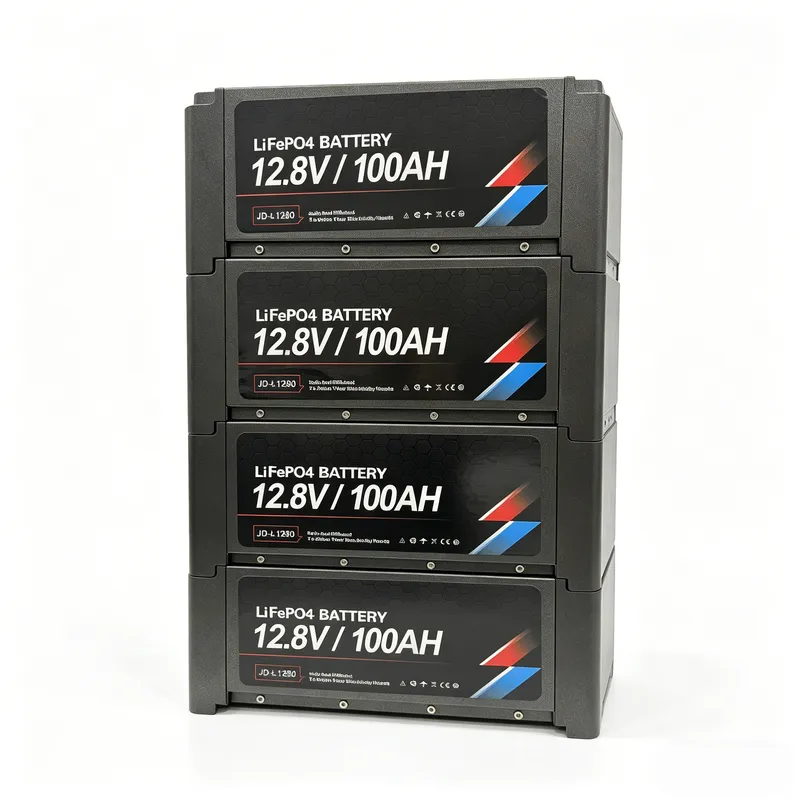
If you have a standard 12.8V 100Ah LiFePO4 battery, its total energy capacity is:
If you are using a heavy-duty 51.2V 300Ah floor-standing battery system, its capacity is:
Step 2: Account for Peak Sun Hours (Location Matters)
Solar panels do not output their maximum wattage all day long. They rely on Peak Sun Hours—the equivalent number of hours per day when solar irradiance averages $1000\text{W/m}^2$.
In tropical and sunny regions like Nigeria, South Africa, and Kenya, the average peak sun hours range from 4.5 to 6 hours per day.
For calculation safety, it is standard practice to use 5 hours as a benchmark.
Step 3: Factor in System Efficiency Loss
No solar system is 100% efficient. Energy is lost through dirt on panels, wire resistance, and the conversion process inside the MPPT hybrid solar inverter.
Generally, a high-quality off-grid system operates at about 80% efficiency (a $1.25$ multiplier factor).
Step 4: The Golden Sizing Formula
Now, we combine everything into the ultimate solar panel wattage calculator formula:
Let’s run a real-world example:
Supposing you want to fully charge a 12.8V 200Ah (2560Wh) stackable lithium battery in one sunny day:
Battery Capacity: $2560\text{Wh}$
Divided by 5 Peak Sun Hours: $2560 / 5 = 512\text{W}$
Account for 80% Efficiency ($1.25$ factor): $512\text{W} \times 1.25 = 640\text{W}$
Conclusion: You will need at least 640 Watts of solar panels. You can achieve this by installing two $330\text{W}$ solar panels or one heavy-duty $650\text{W}$ panel.
Quick Reference Sizing Table for SolarZS Systems
To make it easier for our wholesale partners and distributors, here is a quick matching guide based on standard SolarZS energy storage configurations:
| Battery Specification | Total Capacity (Wh) | Recommended Minimum Solar Array (W) | Typical Panel Setup |
| 12.8V 100Ah Pack | 1,280 Wh | 320W | 1 * 330W Panel |
| 12.8V 200Ah Pack | 2,560Wh | 640W | 2 * 330W Panels |
| 25.6V 100Ah Pack | 2,560Wh | 640W | 2 * 330W Panels |
| 51.2V 160Ah System | 8,192Wh | 2,050W | 4 * 550W Panels |
| 51.2V 300Ah Cabinet | 15,360Wh | 3,840W | 7 * 550W Panels |
Looking for Hassle-Free Solar Integration?
Calculating and wiring separate panels, inverters, and lithium cells can be complicated for end-users. That is why SolarZS developed our signature All-in-One Solar System ESS.
Our pre-engineered hybrid systems combine pure sine wave inverters, smart MPPT controllers, and premium LiFePO4 battery storage into a single mobile cabinet. It is a true plug-and-play solution designed to survive local grid instability with zero installation headaches.
Are you a solar product importer, wholesaler, or installation contractor in Africa? Contact the SolarZS factory expert team today to get bulk pricing, OEM customization options, and optimized shipping container loading solutions!